Manufacturing
Custom Software for Manufacturers. Live in 45 Days.
OEE dashboards, maintenance, quality and supplier portals, built around your shop floor rather than a vendor's idea of it. Backed by a fractional CTO with 20 years in automotive.
- Automotive Tier 2/3
- Aerospace
- Industrial
- Food & Process

In short
Last updated
Day45th builds custom manufacturing software (OEE dashboards, maintenance apps, quality and CAPA tracking, supplier portals and ERP add-ons) for small and mid-size plants in the US, UK and Europe. Each project is fixed-price, goes live in 30–45 days, is penetration-tested before launch, and you own 100% of the code. There are no per-seat or per-station licences, ever.
On this page
- 01 The shop floor runs on spreadsheets
- 02 What is custom manufacturing software?
- 03 What we build for plants
- 04 How much does custom manufacturing software co…
- 05 How a manufacturing project runs
- 06 Custom vs. off-the-shelf vs. doing nothing
- 07 Integrations and shop-floor connectivity
- 08 Security for manufacturers
- 09 Why plants choose Day45th
- 10 FAQ
- 11 Glossary
The shop floor runs on spreadsheets. Your margins pay for it.
Walk any mid-size plant and you'll find the same thing: a perfectly decent ERP in the office, and everything that actually happens on the floor living somewhere else. Downtime is written on a whiteboard. Maintenance is a binder. Quality issues sit in an Excel file that one person understands. Supplier updates arrive by email at 6 p.m.
It isn't laziness. The software that would fix it has always been priced for the Fortune 500.
-
54%
of small and mid-size plants still run shop-floor execution on paper or spreadsheets, and only 8% use a commercial MES.
Source: IoT Analytics, 2025
-
About half of US manufacturers under 50 employees remain at a manual or basic level of digital maturity.
Source: Lasso SMB manufacturing survey, Q1 2026
-
55%
of manufacturers still rely on manual or spreadsheet reporting.
Source: Tacton, 2025
-
Nearly half of manufacturers regret a recent software purchase, most often because it cost more than expected (38%) or implementation went badly (35%).
Source: Software Advice, 2025
So plants end up choosing between a $200,000 system they'll use 20% of, and a spreadsheet that breaks every time someone sorts column C. There's now a third option.
What is custom manufacturing software?
Custom manufacturing software is an application built for one plant's specific processes, such as tracking downtime, scheduling maintenance, managing quality issues or sharing orders with suppliers, rather than a generic product configured to fit. It usually sits alongside your ERP, reading and writing data through APIs, so the ERP stays the system of record while the floor gets tools people actually use.
Until recently, custom software meant six-figure budgets and nine-month timelines. AI-assisted development has cut the cost of the repetitive parts of building it (data models, screens, tests, integrations), so a focused manufacturing app can now be built and secured in weeks.
What we build for plants
Pick one wedge, ship it in 45 days, prove the ROI, then expand.
-
OEE & production dashboards
- Problem
- Nobody agrees on why Line 3 underperformed last Tuesday.
- What we build
- Live availability, performance and quality (OEE) by line, shift and product, fed from machine signals, operator tablets or your existing spreadsheets. Downtime reasons are captured in two taps.
- Outcome
- One version of the truth on a TV by the line and in the morning meeting, and a ranked list of the losses worth fixing first.
-
Maintenance management (CMMS-lite)
- Problem
- Preventive maintenance lives in a binder and spare parts in someone's head.
- What we build
- Work orders, PM schedules, asset history and spare-parts stock on a phone, with photos, QR codes on machines, and offline mode for the far corner of the plant.
- Outcome
- Fewer surprise breakdowns, and no per-technician licence fees as the team grows.
-
Quality, CAPA & PPAP
- Problem
- Non-conformances, 8D reports and PPAP packs are scattered across email and shared drives the week before an audit.
- What we build
- NCR capture at the point of discovery, guided 8D/CAPA workflows with owners and due dates, and PPAP document packs assembled automatically.
- Outcome
- Audit-ready records for IATF 16949 or AS9100, and a customer who sees you close issues fast.
-
Supplier & dealer portals
- Problem
- Order confirmations, ASNs, certificates and warranty claims live in inboxes.
- What we build
- A secure portal where suppliers confirm orders and upload documents, and dealers raise warranty claims and track status.
- Outcome
- Your buyers stop chasing, and you keep a clean audit trail.
-
ERP add-ons & integrations
- Problem
- Your ERP is fine for finance and inventory, but a module upgrade or re-implementation has been quoted at six figures.
- What we build
- The missing screens and workflows, integrated with Epicor, SAP Business One, NetSuite, Odoo, Infor or Plex through supported APIs.
- Outcome
- You extend the ERP you have instead of replacing it.
-
Traceability & labelling
- Problem
- A customer complaint turns into a two-day lot-tracing exercise.
- What we build
- Barcode or QR traceability from raw material to shipped part, with genealogy reports in seconds.
- Outcome
- Recalls and audits that take minutes, not days.
-
Production scheduling
- Problem
- The schedule is a spreadsheet that's out of date by 10 a.m.
- What we build
- A visual scheduler that respects machine capacity, changeovers and material availability, and updates as jobs finish.
- Outcome
- Fewer expedites and more on-time deliveries. Scheduling is the top digital priority for SMB manufacturers.
Lasso, 2026
-
CMMC / TISAX readiness support
- Problem
- A defence prime or a German OEM wants security evidence you don't have.
- What we build
- Penetration testing, secure-configuration reviews and documented controls for your auditors.
- Outcome
- Faster supplier approvals.
We support preparation; certification is issued by accredited assessors.
How much does custom manufacturing software cost?
Costs depend on scope, integrations and how many sites you have, but published market ranges give a useful benchmark:
| What you're buying | Typical market cost | Source |
|---|---|---|
| ERP subscription (Epicor, SAP B1, NetSuite) | ~$80–$250 per user per month | Reseller estimates, 2025–26 |
| ERP implementation | ~$50,000–$300,000 | Reseller and analyst estimates, 2025–26 |
| Commercial OEE system, year one (incl. hardware) | ~$20,000–$80,000 | Vendor and agency estimates, 2025 |
| Standalone custom OEE dashboard (agency-built) | ~$13,000–$25,000 | Agency estimates, 2025 |
| Custom SMB MES (agency-built) | ~$25,000–$75,000 | Agency estimates, 2025 |
| CMMS SaaS | ~$20–$75 per user per month | Vendor pricing, 2025 |
Swipe to compare →
How Day45th prices: a fixed price after a free 30-minute call and a one-week blueprint. You know the total before any code is written, and there are no per-user, per-station or per-site fees afterwards. Most plants start with one module (often OEE or maintenance) and expand once the first one pays for itself.
How a manufacturing project runs
- Day 0
plant walkthrough call (free)
We look at the process, the data you already have and what it costs you today. If software isn't the answer, we say so.
- Days 1–7
blueprint and fixed price
Screens, data model, integrations, hardware needs (tablets, scanners, sensors) and a fixed price, signed before we build.
- Days 8–38
build with weekly demos
You see working software every Friday on real plant data. Operators try it early, which is why they adopt it.
- Days 39–45
harden, test, train, go live
VAPT, load testing, ERP integration tests, operator training and a supported go-live on one line or one site.
- 05
After launch: expand
Roll out to more lines and sites, or add the next module, on the optional care plan.
Custom vs. off-the-shelf vs. doing nothing
| Item | Spreadsheets & whiteboards | Off-the-shelf MES / CMMS | Custom with Day45th |
|---|---|---|---|
| Upfront cost | None | Licences + implementation | Fixed build price |
| Ongoing cost | Hidden (errors, downtime, admin) | Per user / station / site, rising yearly | Optional flat care plan |
| Fit to your process | Perfect, until it breaks | You adapt to the software | Built around your process |
| Time to value | n/a | 3–12 months typical | 30–45 days |
| Data ownership | Yours, scattered | Vendor's cloud and format | Yours, in your cloud |
| Works with your ERP | Copy-paste | Connector, often extra cost | Integrated via APIs |
Swipe to compare →
Integrations and shop-floor connectivity
-
ERP
Epicor Kinetic, SAP Business One, Oracle NetSuite, Odoo, Infor, Plex, Microsoft Dynamics 365
-
Machine data
OPC UA, MQTT, Modbus gateways, existing historians, PLC data via edge gateways (read-only by default)
-
Devices
rugged tablets, barcode/QR scanners, label printers, TV dashboards
-
Business tools
Microsoft 365, Google Workspace, Teams/Slack alerts, Power BI
-
Identity
SSO via Microsoft Entra ID or Google
We never write to PLCs or change control logic. Shop-floor integrations are read-only unless you explicitly ask otherwise.
Security for manufacturers: OT, supply chain and customer audits
Cybersecurity is now manufacturers' biggest external concern after the economy. (Rockwell Automation State of Smart Manufacturing, 2025) And customers increasingly make it a condition of doing business:
-
CMMC (US defence supply chain)
the final rule took effect with Phase 1 on 10 November 2025, affecting an estimated ~337,000 contractors, most of them small.
US DoD, 2025
-
TISAX (European automotive)
single-site SMEs commonly spend ~€15,000–€80,000 preparing.
Industry estimates, 2025
Every Day45th release goes through threat modelling, senior code review, dependency and secret scanning, and VAPT before go-live, and you receive the report. Shop-floor data paths are segmented and read-only by default, hosted in your cloud and region.
Why Day45th
Why plants choose Day45th
-
We speak manufacturing
Our fractional CTO spent 20 years in automotive and enterprise IT. PPAP, APQP, OEE and takt time won't need explaining.
-
We extend your ERP
No rip-and-replace and no year-long implementation.
-
Fixed price, fixed date
If we got the estimate wrong, that's our problem.
-
You own it
Code in your repository, app in your cloud, with no per-seat, per-station or per-site licences.
-
Security first
VAPT on every release, which matters when OT and supplier data are involved.
FAQ
Questions, Answered
What is the best software for a small manufacturer?
For most small and mid-size plants it's the ERP you already have, extended with focused tools for the floor: OEE, maintenance, quality and scheduling. Replacing the ERP is rarely the cheapest fix.
Can you connect to our machines and PLCs?
Yes, via OPC UA, MQTT, edge gateways, existing historians or simple CSV exports to start. We always choose the lowest-risk path and never change control logic.
Do you replace our ERP?
Usually not. We extend Epicor, SAP Business One, NetSuite, Odoo and others through their APIs. If an ERP module is genuinely the problem, we show you the numbers first.
How long does a manufacturing software project take?
Most first modules go live in 30–45 days: one week for the blueprint, about four weeks of building with weekly demos, and one week of testing and training.
How much does an OEE dashboard cost?
Market estimates for agency-built OEE dashboards run roughly $13,000–$25,000, and commercial systems ~$20,000–$80,000 in year one. Day45th quotes a fixed price after a one-week blueprint.
Do operators actually use it?
They do when they help design it. Operators see working screens every week and we build for gloves, noise and two-tap input.
Does it work offline on the shop floor?
Yes. Mobile and tablet apps cache work and sync when Wi-Fi returns.
How do you handle OT security?
Read-only data paths by default, network segmentation, least-privilege access and a penetration test before go-live.
Can you help us pass a CMMC or TISAX assessment?
We help you prepare with pen tests, secure-configuration reviews and documented controls. Certification itself is issued by accredited assessors.
Who owns the software?
You do, contractually, from day one: code, data and IP.
Glossary
- OEE (Overall Equipment Effectiveness)
- availability × performance × quality; the standard measure of how productive a line is.
- MES (Manufacturing Execution System)
- software that tracks and controls production on the shop floor.
- CMMS (Computerised Maintenance Management System)
- software for work orders, preventive maintenance and spare parts.
- CAPA / 8D
- structured methods for finding the root cause of quality problems and preventing recurrence.
- PPAP
- Production Part Approval Process, the documentation automotive customers require before approving a part.
- IATF 16949
- the automotive quality management standard.
- CMMC / TISAX
- cybersecurity frameworks for US defence suppliers and European automotive suppliers.
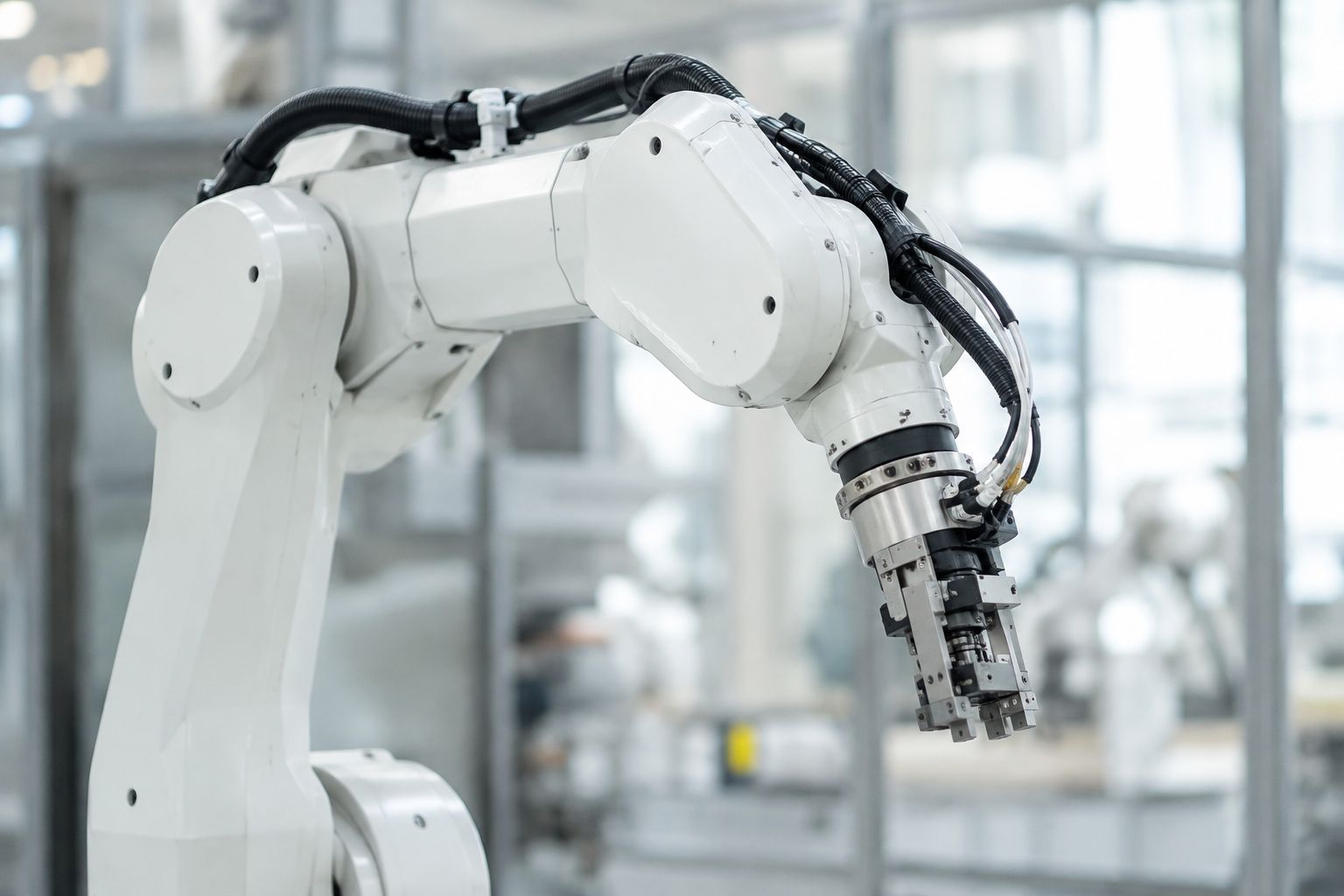
Built for Manufacturing
Let's Fix One Line First.
Book a free 30-minute plant walkthrough call. Bring your downtime log, your maintenance binder or your ERP quote. You'll leave with an honest recommendation and a fixed price, or a clear "don't build this."